The BISP Eligibility Criteria 2026 explains which low-income families can receive direct financial assistance from the Benazir Income Support Programme (BISP). To qualify, households must meet requirements like low income, NSER registration, valid CNIC, and PMT score below threshold. Following these rules ensures beneficiaries receive timely and secure BISP payments.
| Eligibility Factor | Requirement | Details |
|---|---|---|
| Household Income | Below poverty line | Verified through NSER survey to identify needy families |
| NSER Registration | Must be registered | Collects data on income, assets, education, and living conditions |
| CNIC Verification | Valid CNIC required | Checked with NADRA for authenticity |
| PMT Score | Below set threshold | Determines financial vulnerability of households |
| Employment Status | No government job or pension | Ensures aid reaches truly needy families |
| Vulnerable Groups | Priority for women-headed households, widows, disabled | Helps marginalized families |
| Beneficiary Limit | One person per household | Prevents multiple claims from same household |
| Assets & Utilities | No excessive property or high utility bills | Ensures aid goes to poorest families |

Low-Income Household Requirement
To receive BISP payments in 2026, households must be low-income or poor. Only families whose monthly income is below the official poverty line are eligible. This ensures financial aid reaches the most deserving families. Families with stable income are not eligible.
Key Points:
- Only low-income households considered
- Priority given to families with no steady income
- Poverty is assessed through NSER survey

NSER Registration and Verification
Every household must be registered in the National Socio-Economic Registry (NSER) to qualify for BISP 2026 payments. NSER collects data like income, education, assets, and living conditions. A Poverty Means Test (PMT) score is calculated to determine eligibility. Only households listed in NSER can receive BISP cash assistance.
Important Notes:
- Accurate NSER registration is mandatory
- PMT score determines eligibility
- Update household info if necessary
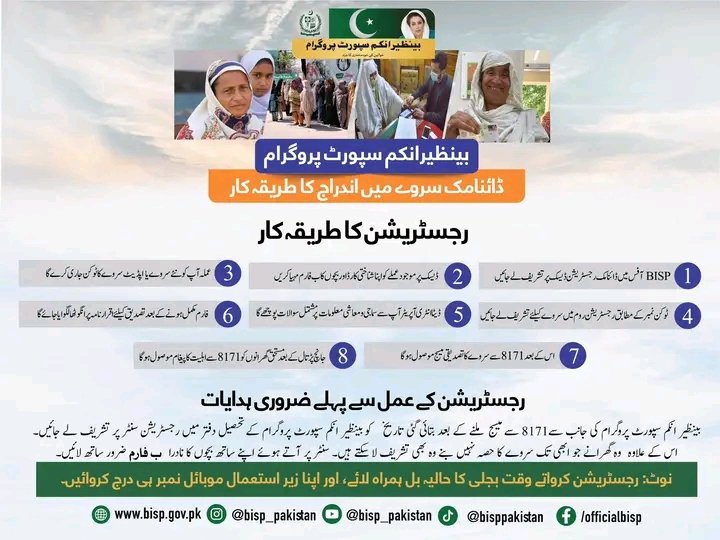

CNIC Verification Requirement
A valid CNIC is required for BISP eligibility 2026. CNIC is verified by NADRA to ensure the beneficiary is genuine. Without a valid CNIC, families cannot receive BISP payments.
Checklist:
- CNIC must be active
- Must match NSER registration
- Keep CNIC info updated for verification
PMT Score and Priority Groups
Eligibility is mainly determined by PMT score. Households with scores below the set threshold are eligible. Vulnerable groups like women-headed households, widows, disabled, and single mothers are prioritized even if their PMT score is slightly higher.
Key Benefits:
- PMT score identifies the poorest families
- Vulnerable households get priority
- Ensures fair and transparent aid distribution
Other Eligibility Rules
Additional rules for BISP 2026 eligibility:
- Only one beneficiary per household
- Households with government employment or pension are excluded
- Families with excessive property or high utility bills may not qualify
- Completing NSER surveys on time is required
Tips for Beneficiaries: - Verify NSER registration and PMT score
- Ensure CNIC and contact info are correct
- Follow official BISP instructions
BISP Helpline: 0800-26477
Official Website: 8171.bisp.gov.pk
Conclusion
The BISP Eligibility Criteria 2026 ensures that financial aid reaches low-income and vulnerable families. Eligible households must have low income, valid CNIC, NSER registration, and PMT score below threshold. Women-headed households, widows, and disabled families are prioritized. Following the official process guarantees secure, timely, and transparent BISP payments.
FAQ – BISP Eligibility 2026
Q1: Who is eligible for BISP payments in 2026?
- Families with low income, NSER registration, valid CNIC, and PMT score below threshold.
Q2: Can government employees receive BISP aid? - No, households with government jobs or pensions are not eligible.
Q3: How is PMT score calculated? - PMT score uses household income, assets, education, and living conditions through NSER survey.
Q4: Can more than one person in a household get BISP payments? - No, only one beneficiary per household is allowed.
Latest Updates
 How To Apply For Ramzan Rashan Program 2026 – Complete Guide
 Latest Update: BISP 8171 Wallet Account Registration 2026
 How To Register And Check Latest BISP Payment Status 2026
 Today Update: Ramzan Negahban Card Online Registration 2026 – Get Rs 10,000 Cash Assistance
 Today Update: How To Check Eligibility And Register Online Negahban Ramzan Package
 Today Update: How To Register For PSER Survey 2026 For Ramzan Package And Free Atta?