
The Benazir Income Support Programme (BISP) is Pakistan’s largest social welfare program that provides financial assistance to poor families, especially women. In 2026, BISP continues to support millions of low-income households struggling with poverty and inflation. Many families depend on BISP payments to buy food, pay utility bills, and manage basic health needs.
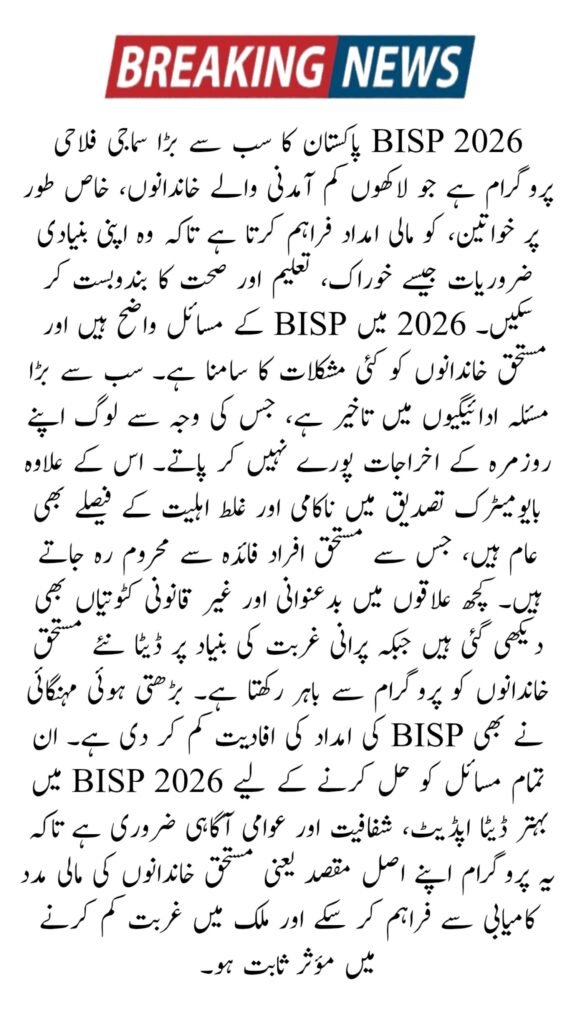
Despite its importance, BISP payments in 2026 are facing many problems. These BISP issues include delayed payments, biometric verification failure, wrong eligibility decisions, corruption, and lack of awareness. These challenges reduce the impact of the program and create serious difficulties for deserving beneficiaries.

Common BISP Problems Faced by Beneficiaries
| No. | Problem Area |
|---|---|
| 1 | Payment delays |
| 2 | Biometric verification failure |
| 3 | Wrong eligibility status |
| 4 | Illegal deductions |
| 5 | Outdated poverty data |
| 6 | Low public awareness |
| 7 | Inflation pressure |
| 8 | Weak complaint system |

Payment Delay Issues in BISP 2026
BISP payment delays in 2026 are the most common complaint among beneficiaries. Poor families rely on quarterly BISP payments for daily expenses. When BISP payments are delayed, households struggle to manage food and utility costs.
The main reasons for BISP payment delay problems include:
- Technical issues in the BISP payment system
- Late release of funds
- Temporary suspension during BISP verification drives
- Incorrect status shown on the 8171 BISP portal
These payment issues in BISP increase financial stress and hardship for poor families.

Biometric Verification Problems in BISP
Biometric verification in BISP is required to receive payments, but it creates difficulties for many beneficiaries. BISP biometric verification failure is especially common among elderly women and laborers.
Major BISP biometric problems include:
- Fingerprints not matching due to age or hard work
- Faulty biometric machines at BISP payment centers
- Internet or electricity problems
- CNIC data mismatch with NADRA records
Repeated biometric issues in BISP 2026 force beneficiaries to visit payment centers multiple times.
Eligibility Errors and Poverty Score Problems
Wrong eligibility decisions in BISP 2026 are another serious issue. Many deserving families are removed from the program due to incorrect poverty scores, while some non-deserving households continue receiving payments.
Common causes of BISP eligibility problems include:
- Outdated BISP poverty survey data
- Income changes not updated in records
- Incorrect household information
- Lack of regular re-surveys in poor areas
These eligibility errors in BISP reduce fairness and trust in the system.
BISP System Reality in 2026
| Area | Current Situation |
|---|---|
| Main beneficiaries | Poor women |
| Payment method | Banks and payment centers |
| Payment cycle | Quarterly |
| Most common complaint | Payment not received |
| Major system issue | Biometric failure |
| Data weakness | Old poverty surveys |
| Awareness level | Low in rural areas |
| Public trust | Declining |
This table highlights the ground reality of the BISP system in 2026 and shows why beneficiaries face continuous problems.
Corruption and Illegal Deductions in BISP
Corruption in BISP remains a serious concern despite digital payments. Many beneficiaries do not receive their full payment due to illegal deductions in BISP.
Common BISP corruption practices include:
- Agents deducting money illegally
- Middlemen charging service fees
- Payments reaching ineligible people
- Use of influence to remain eligible
These illegal practices in BISP reduce the real benefit for poor families and damage trust.
Inflation Impact on BISP Payments
The impact of inflation on BISP payments in 2026 is very high. Even when payments are received on time, the amount is often not enough to meet basic needs.
Major inflation-related BISP challenges include:
- Rising food prices
- Higher utility bills
- Increased medical expenses
- Fixed BISP stipend amount
Due to high inflation, BISP assistance does not fully protect families from poverty.
Lack of Awareness and Weak Complaint System
Lack of awareness about BISP is another major problem. Many beneficiaries do not know how to check payment status or file complaints.
Key BISP communication issues include:
- Fake SMS and scam calls
- Poor guidance at BISP offices
- Slow response to complaints
- Low digital literacy among beneficiaries
For correct and official information, beneficiaries should use only the official BISP website:
https://www.bisp.gov.pk
Conclusion
In 2026, the Benazir Income Support Programme remains a vital support system for millions of poor families in Pakistan. However, BISP problems such as payment delays, biometric failures, eligibility errors, corruption, inflation pressure, and lack of awareness reduce its effectiveness. Improving data accuracy, strengthening monitoring, and increasing public awareness can help BISP deliver better support to deserving beneficiaries.
Frequently Asked Questions (FAQs)
Why are BISP payments delayed in 2026?
BISP payments are delayed due to system issues, verification drives, and late fund releases.
What causes biometric verification failure in BISP?
Biometric failure in BISP happens because of fingerprint issues, machine faults, or CNIC mismatch.
Is it legal to deduct money from BISP payments?
No, any deduction from BISP payments is illegal and should be reported immediately.
Where can beneficiaries get official BISP information?
Only from the official BISP website or verified 8171 BISP messages.
Latest Updates
 How To Apply For Ramzan Rashan Program 2026 – Complete Guide
 Latest Update: BISP 8171 Wallet Account Registration 2026
 How To Register And Check Latest BISP Payment Status 2026
 Today Update: Ramzan Negahban Card Online Registration 2026 – Get Rs 10,000 Cash Assistance
 Today Update: How To Check Eligibility And Register Online Negahban Ramzan Package
 Today Update: How To Register For PSER Survey 2026 For Ramzan Package And Free Atta?